
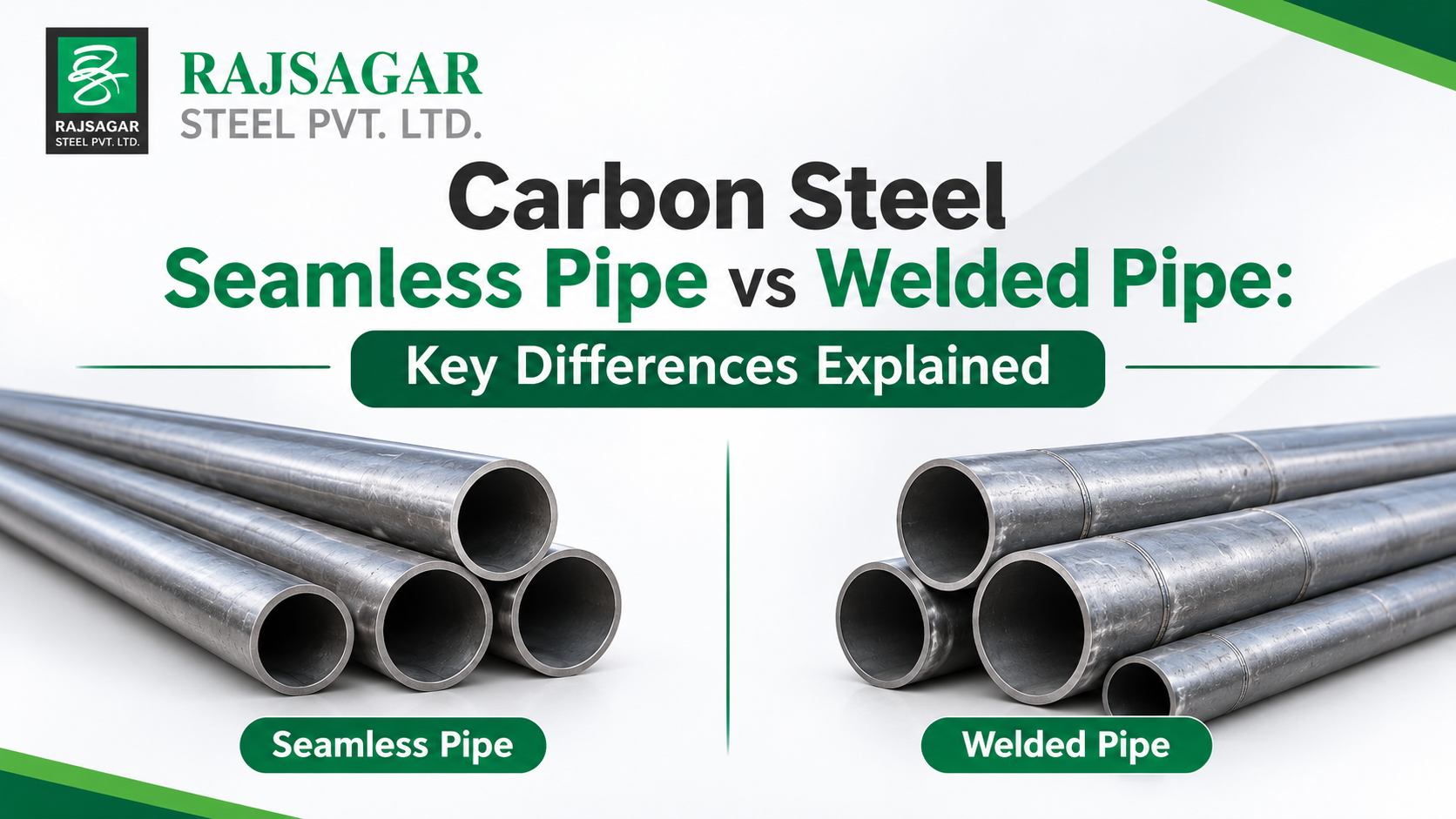
Every pipeline engineer eventually faces the same question: seamless or welded? Carbon steel seamless pipes and carbon steel welded pipes both move fluids, support structures, and carry loads across oil and gas, construction, and process industries. The manufacturing process separates the two, and that single distinction shapes everything downstream, from seamless pipe vs welded pipe strength to pressure rating and price. This guide breaks down what changes when a pipe has no seam at all.
What Is a Carbon Steel Seamless Pipe?
A solid round billet becomes a carbon steel seamless pipe once mills heat it and pierce it through the centre, leaving a hollow tube with no joint anywhere along its length. Rotary piercing or extrusion shapes the tube, and welding never enters the process. This uniform, one-piece wall gives a seamless pipe a higher tolerance for internal pressure and cyclic stress than a jointed alternative. RSPL’s hot-finished seamless pipes cover 2″ to 16″ OD, built for oil and gas lines, boilers, and high-pressure systems where a weld seam would introduce a weak point.
What Is a Carbon Steel Welded Pipe?
Rolling a flat steel strip or plate into a cylindrical shape, then joining it along a longitudinal or spiral seam using ERW, SAW, or similar welding methods, produces a carbon steel welded pipe. This process allows manufacturers to produce much larger diameters than piercing permits, often beyond 24 inches. Wall thickness and length stay flexible too, since manufacturers cut the plate feedstock to size before rolling. Welded pipe generally costs less to produce, which makes it the practical choice for large-diameter pipelines carrying water, gas, or structural loads at moderate pressure.
Carbon Steel Seamless Pipe vs Welded Pipe: Key Differences
Six factors decide which pipe type fits a project: how it is made, how much pressure it handles, what sizes it comes in, surface quality, cost, and end use.
| Parameter | Seamless Pipe | Welded Pipe |
| Manufacturing Process | Pierced from a solid billet, no seam | Rolled from plate or strip, joined by welding |
| Strength & Pressure Handling | Higher burst strength, uniform wall under pressure | Slightly lower rating at the weld line unless heat-treated |
| Size & Dimensional Availability | 2″ to 16″ OD (hot finished), 10 mm to 108 mm OD (cold drawn) | Larger diameters available, often beyond 24″ OD |
| Surface Finish & Consistency | Consistent wall thickness, no visible seam | Visible weld line, minor thickness variation near the seam |
| Cost | Higher production cost | Lower production cost, more economical |
| Application Suitability | High-pressure, high-temperature, critical service | Low-to-medium pressure, structural, general use |
Applications of Seamless and Welded Carbon Steel Pipes
Pressure rating and service conditions decide where each pipe type performs best. The sections below list where seamless and welded carbon steel pipes see actual field use.
Seamless Pipes
- Oil & Gas sector: reliably moves crude oil and natural gas at high pressure through pipelines, refineries and offshore platforms.
- Boilers & Heat Exchangers: resist repeated thermal cycling and internal pressure found in steam and heat transfer systems in power plants.
- Pressure Vessels: hold pressurised gases and liquids in petrochemical and fertilizer plant vessels without seam-related failure risk.
- Power Plants: supply steam and feedwater lines operating above 100 bar in thermal and nuclear generation units.
- Automotive & Bearing Industry: forms precision tubing for hydraulic cylinders, axles, and bearing races that need consistently tight dimensional tolerances.
Welded Pipes
- Water Pipelines: economically transport municipal and industrial water supply over long distances at low to moderate pressure.
- Applications: frames, building columns, scaffolding and fencing structures where load-bearing strength is more important than internal pressure rating.
- Construction Industry: supports ducting, casing, and piling work on residential, commercial, and industrial construction sites across regions.
- Low-to-Medium Pressure Systems: handle HVAC ducting, plumbing, and irrigation lines that operate well under 1000 PSI service pressure.
- General Industrial Use: serves conveyor frames, storage tanks, and general fabrication work where cost efficiency outweighs high-pressure demands.
How to Choose Between Seamless and Welded Pipes
Selecting the right pipe type depends on more than budget. These factors help match the pipe to the actual operating environment and project requirements.
- The decision to pay the premium for a higher-strength seamless pipe compared to a welded equivalent is driven by the operating pressure and temperature.
- The choice is restricted by the required pipe size, wall thickness and dimensional tolerance, as welded pipes are available in a wider size range.
- Where seamless pricing gets hard to justify, project budget and specifications often favour welded pipe for large volumes.
- Applicable ASTM or API standards and the specified material grade dictate which manufacturing process meets code requirements.
- Safety and performance requirements of the application should guide the final decision more than upfront material cost.
Conclusion
Welded pipes are available in large sizes and are less expensive to produce. Carbon steel seamless pipes have higher pressure ratings and uniformity of structure. No type is suitable in every situation for different industries. The correct choice is driven by operating pressure, dimensional constraints, relevant ASTM or API specifications and the total project budget. Rajsagar Steel Pvt. Ltd, an ISO 9001:2008 certified manufacturer from Gujarat, produces hot-finished seamless pipes and cold-drawn tubes in multiple size ranges and applications.