
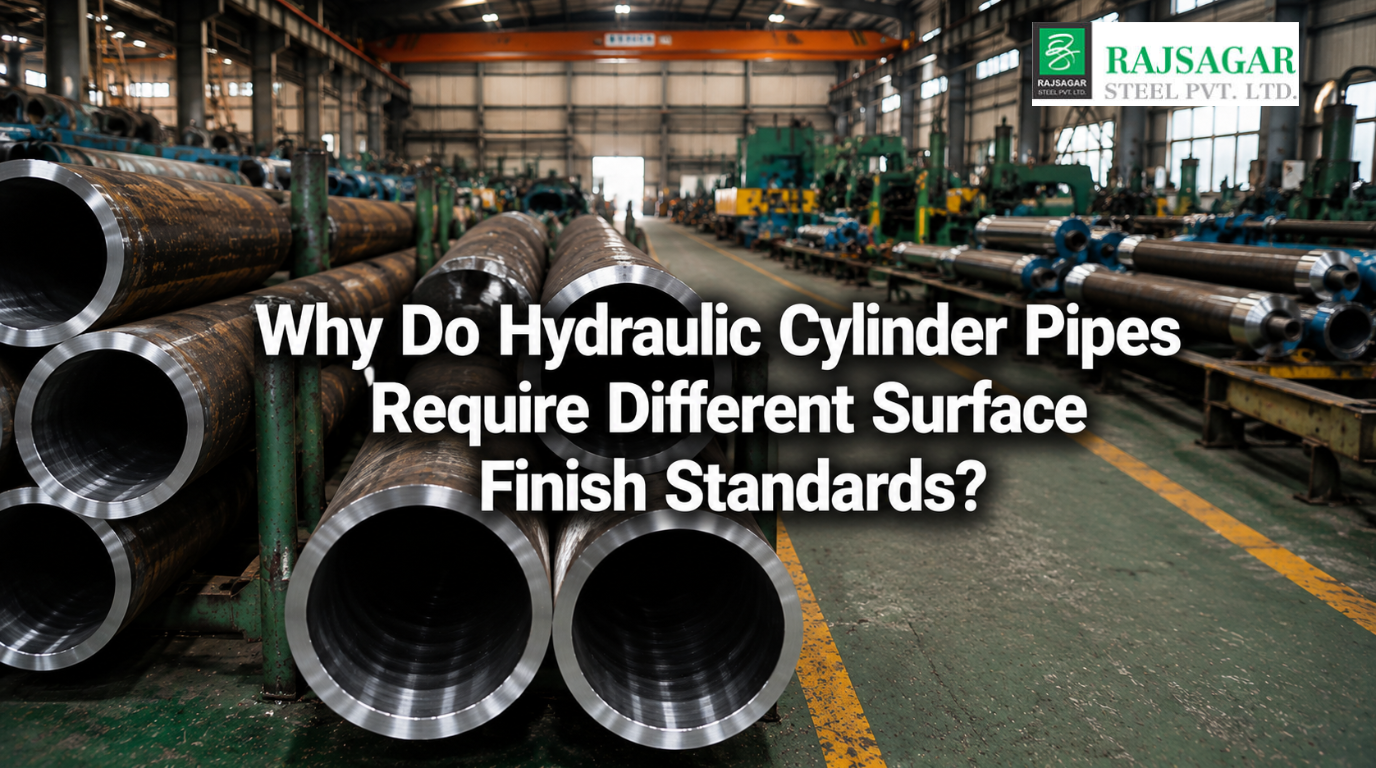
A hydraulic cylinder pipe forms the pressure boundary and guide surface for the piston inside every hydraulic cylinder. The bore finish decides how well the piston seals, how smoothly it travels, and how long the cylinder runs before it needs a rebuild. A softer bore tears through seals within months, while a bore polished past the working range dries out the piston of the oil film it needs to move without scoring. This blog explains why finish standards shift between applications and what that means for the pipe you choose.
What is a Hydraulic Cylinder Pipe?
A hydraulic cylinder pipe is the tube that forms the cylinder barrel, holding the piston, rod, and hydraulic fluid under pressure. It absorbs radial load while its internal bore guides the piston through repeated strokes without letting fluid bypass the seals. Wall thickness and bore diameter stay within tight tolerances because any deviation changes how the piston seats against the bore surface. Seamless Hydraulic Cylinder Pipe is the standard choice across mobile and industrial equipment: made from a single billet with no weld seam, it removes a failure point that welded tube carries, giving fewer leak paths and consistent bore geometry end to end.
What is Surface Finish in Hydraulic Cylinder Pipes?
Surface finish describes the micro-level texture left on the bore after machining, measured as Ra, the arithmetic average roughness in micrometers. A honed hydraulic cylinder bore falls between 0.2 and 0.4 micrometers Ra: fine enough to hold a grease-like oil film, textured enough to retain it under piston motion. That texture governs seal-lip friction, oil-film survival, and wear rate under load. Get it wrong in either direction and the pipe works against the seal instead of with it.
Why Hydraulic Cylinder Pipes Require Different Surface Finish Standards?
To Ensure Proper Seal Performance
Seal lips need a bore surface fine enough to maintain contact without losing the oil film underneath. Too rough, and fluid escapes along microscopic valleys in the bore wall. Too smooth, and the seal rides dry, wearing out before its rated cycle life. Finish specs sit in a narrow band for this reason.
To Reduce Friction and Wear
A properly polished bore makes the piston and seal glide on a thin, stable oil film. That cuts heat at the seal lip, keeping the compound elastic longer and delaying the point where it hardens and starts to leak.
To Meet Different Pressure Requirements
Systems running above 3000 PSI push seals harder into the bore wall, so a surface irregularity turns into a leak path faster than it would at 1500 PSI. High-pressure cylinder pipe needs a finer Ra target and tighter roundness tolerance than a pipe built for a low-pressure lift application.
To Improve Corrosion Resistance
A rough bore surface holds moisture and contaminants in its peaks and valleys long after the rest of the pipe has dried, and those pockets become starting points for pitting, especially in marine equipment and construction machinery exposed to washdown. A finer, uniform finish leaves corrosion fewer places to take hold.
To Increase Service Life
Scoring, pitting, and seal extrusion all start at the bore surface, shortening the interval between rebuilds. A pipe finished to the correct Ra value outlasts several seal replacement cycles before the bore itself needs reworking, shifting the maintenance burden to the cheaper part: the seal kit.
Different Applications Have Different Finish Requirements
Construction equipment cycles through dust and shock loads that agricultural machinery rarely sees, marine hydraulics fight salt exposure that industrial presses never encounter, and automation systems run at a higher stroke rate. Each combination pushes the ideal Ra target in a different direction, so manufacturers specify finish standards per application rather than one blanket number.
Common Surface Finishing Processes for Hydraulic Cylinder Pipes
Honing removes tool marks left by boring and redirects the bore to its final Ra target using abrasive stones that rotate and stroke at once. Skiving and roller burnishing combine a cutting pass with a cold-working pass, hardening the bore surface while closing microscopic pores in one operation. Precision boring establishes the bore diameter and roundness before finishing begins, while internal polishing further refines the finish, ensuring that higher-pressure applications require a smoother oil film. Seamless Hydraulic Cylinder Pipe responds well to all four since it starts from a uniform wall with no weld seam to disrupt the finish.
How to Choose the Right Hydraulic Cylinder Pipe?
Match the pipe to the system’s rated operating pressure first, since that number drives the rest of the spec sheet. Confirm the Ra value and roundness tolerance in writing, and check wall thickness and bore diameter against the piston and seal dimensions in use. Before placing an order, run through this checklist:
- Confirm rated operating pressure and duty cycle
- Calculate the bore Ra value and roundness tolerance
- Match wall thickness and bore diameter to existing piston and seal specs
- Confirm seal and hydraulic fluid compatibility
- Ask for inspection reports and material certification before shipment
Integrated construction removes weld-seam risk for high-cycle applications. Rajsagar Steel PVT. LTD. supplies seamless hydraulic cylinder pipe with verified Ra values and inspection reports, giving buyers the paperwork needed to match a pipe to its duty cycle before production.
Conclusion
Surface finish sets how long the seals last, how much friction the piston fights on every stroke, and how well the pipe resists corrosion in the field. Choosing the right Ra value and tolerance for the operating pressure and environment avoids premature seal failure and reduces sudden interruptions. Rajsagar Steel PVT. LTD. supplies a welded hydraulic cylinder pipe finished and certified to the tolerances each application needs. Contact us for a quote matched to your cylinder’s pressure rating and bore finish requirement.