
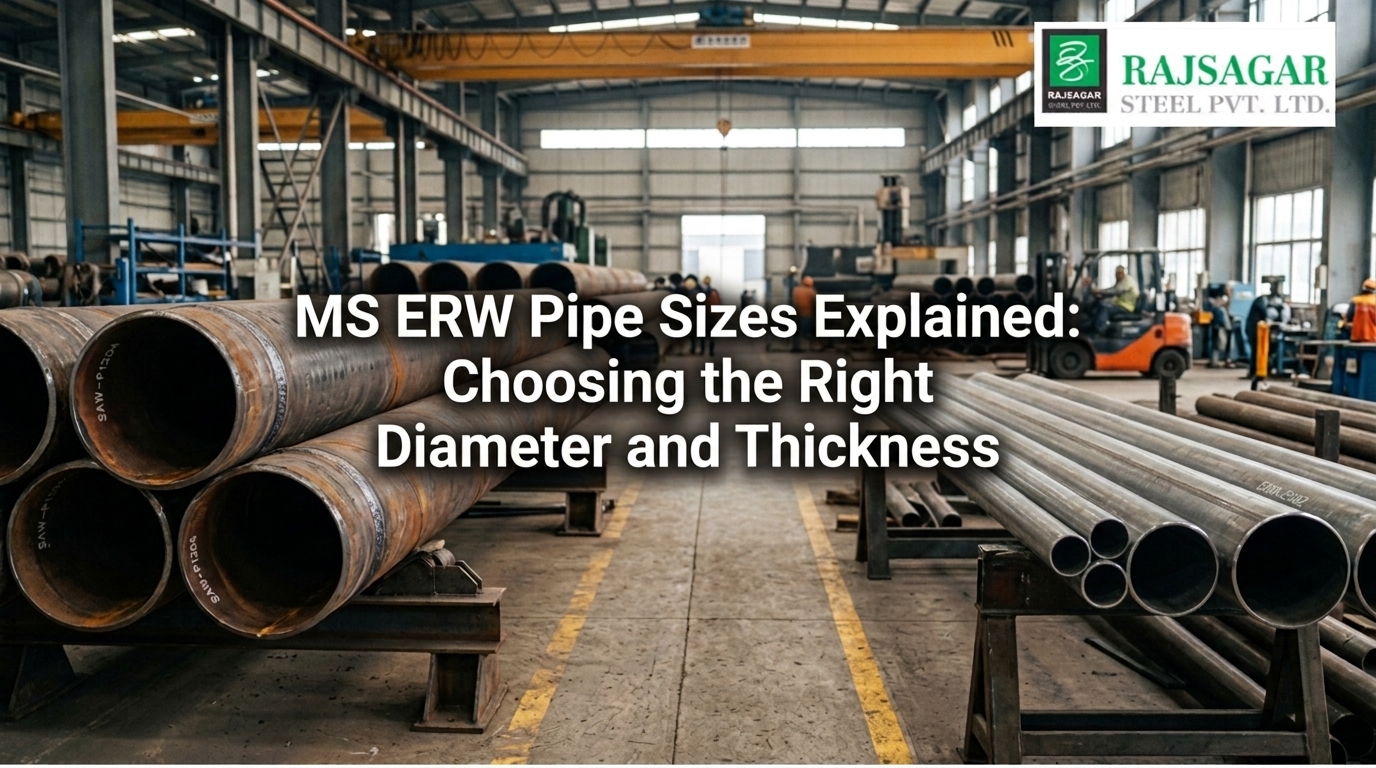
Selecting the wrong wall thickness for an MS ERW pipe can either increase project costs unnecessarily or result in insufficient pressure capacity. Diameter sets how much fluid or gas the pipe carries; wall thickness sets how much pressure it can withstand before it deforms. Getting both right at the ordering stage saves rework and keeps a project on schedule.
Understanding MS ERW Pipe Dimensions
Six measurements define every ERW pipe order. Nominal Bore (NB) is the size designation used in the industry, not the pipe’s actual measured diameter. The outside diameter (OD) is the exact measurement across the pipe’s outer edge, and it remains for a given NB. Wall Thickness is the distance between the outer and inner surfaces, and Inside Diameter (ID) is simply OD minus twice the wall thickness.
Pipe length directly affects transport, storage, and handling requirements. Random lengths run 5.8 to 6.4 metres unless a fixed length is specified. Pipe Schedule expresses wall thickness relative to OD Schedule 40 and 80 are common references, though buyers routinely order ERW pipe by direct millimeter thickness instead.
How to Read an MS ERW Pipe Size Chart
An MS ERW Pipe Size Chart lists NB against OD, then shows the available wall thickness options for that size. Sizes run from 15 NB (21.3 mm OD) up to 300 NB (323.9 mm OD), with larger diameters available for structural and line pipe work. Since OD is standardised for each NB designation, it is generally not a selectable parameter.
Wall thickness selection is typically the primary design consideration. OD tolerance runs ±1%, while wall thickness tolerance sits at -12.5% under IS 1239, a detail that matters when calculating minimum burst pressure. Match your selection to the project’s flow rate and pressure need, not the nearest available size.
| NB (mm) | OD (mm) | Wall Thickness Options (mm) |
| 25 | 33.7 | 2.6, 3.2, 4.0 |
| 50 | 60.3 | 3.2, 3.9, 4.5 |
| 100 | 114.3 | 3.6, 4.5, 5.4 |
| 150 | 168.3 | 4.0, 4.5, 5.4 |
Choosing the Right Diameter for Different Applications
Diameter selection depends on how much fluid or gas moves through the line and at what velocity. A structural column needs a diameter chosen for load-bearing cross-section; a water supply line needs one sized for flow rate at an acceptable pressure drop. Process piping runs larger diameters to keep flow velocity low and cut erosion at fittings.
| Pipe Diameter | Typical Applications | Recommended Use |
| 15–25 NB | Plumbing, gas lines | Low-flow domestic and small commercial supply |
| 32–80 NB | Water supply, HVAC | Medium-flow distribution networks |
| 100–200 NB | Industrial piping | High-flow process and fire-fighting lines |
| 250 NB and above | Structural, cross-country lines | Load-bearing columns and bulk transport |
How Wall Thickness Affects Pipe Performance
Thicker walls raise pressure capacity but add weight and cost. Underground water lines need enough wall thickness to resist soil load and internal pressure combined, while an above-ground structural column can run lighter since it carries axial load, not internal pressure.
| Thickness | Strength | Weight | Pressure Capacity | Typical Applications |
| Light (2.0–3.2 mm) | Moderate | Low | Low pressure only | Fencing, low-pressure gas |
| Medium (3.2–4.5 mm) | Good | Medium | Medium pressure service | General water and HVAC lines |
| Heavy (4.5 mm+) | High | High | High pressure and structural loads | Process piping, structural columns |
Understanding MS ERW Pipe Weight and Specifications
Pipe weight is computed from OD, wall thickness, and length. Standard steel density figures. The weight goes up with heavier walls and larger diameters. This amount depends on the transport cost and crane capability, so buyers usually check the weight using an MS ERW Pipe Weight Chart at the time of procurement.
MS ERW Pipe Specification is often IS 1239, IS 3589, ASTM A53 or EN 10217, depending on the market for which it is intended. Each has its own tolerance bands and criteria for mechanical properties, so check which applies before comparing quotes. A pipe that meets one specification may not meet another minimum yield strength.
Common Mistakes When Selecting MS ERW Pipe Sizes
- Confusing NB with OD, which produces a size order that doesn’t match the required diameter
- Selecting wall thickness by availability rather than calculated pressure requirement
- Ignoring pressure rating and assuming any pipe in the right NB will work
- Choosing the cheapest option without checking the required specification
- Skipping verification of mill test certificates against the order
Practical Buying Tips for MS ERW Pipes
Match pipe size to the actual load and flow requirement before requesting quotes. Check OD, wall thickness and length against the sizing chart, not from memory. Compare shipment weight with transport and site-handling capacity. Undersized cranes cause costly delays. Confirm the pipe carries documentation proving standard compliance before it ships.
Conclusion
Reading an MS ERW Pipe Size Chart correctly, understanding how NB relates to OD, and matching wall thickness to actual pressure and load requirements, together decide whether a pipeline performs as designed. Cross-check the MS ERW Pipe Weight Chart and confirm the applicable MS ERW Pipe Specification before ordering, and the sizing decision stops being guesswork.