
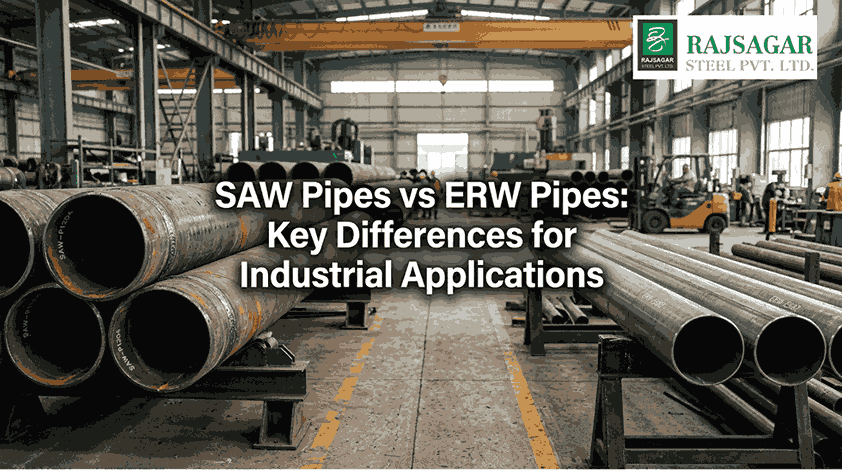
Pipe selection directly affects project performance, pressure ratings, lifecycle costs, and regulatory compliance. Choose the wrong pipe and you are looking at failures, rework, and inspection problems down the line. SAW and ERW are two major welded pipe manufacturing methods. They are not interchangeable. Each suits a different set of project requirements.
Introduction to Welded Pipes in Industrial Applications
Welded pipes are used across oil and gas, petrochemical, water transportation, and infrastructure projects. The applicable standard, the operating pressure, and the diameter requirement all of these drive the selection decision.
API 5L SAW pipes are the standard specification for transmission pipelines and high pressure systems. API 5L covers both SAW and ERW pipe, but the manufacturing process determines the pipe sizes, wall thicknesses and pressure ratings that are possible.
Why Pipe Manufacturing Method Matters
Welding methods influence strength, achievable dimensions, weld zone integrity, and cost. A pipe suited for utility water service is not automatically suited for high-pressure gas transmission. The manufacturing process is what separates these categories.
Understanding API 5L Requirements for Pipeline Systems
API 5L specifies the chemical composition, mechanical properties, dimensional tolerances and testing requirements for pipeline pipes. In API 5L, pipes are classified as PSL1 or PSL2. PSL2 has more stringent toughness and testing requirements. Most important transmission projects require at least PSL2.
Understanding Submerged Arc Welded (SAW) Pipes
SAW pipes are used where large diameters and heavy wall thicknesses are required. They are the standard choice for long-distance transmission lines, offshore pipelines, and high-pressure systems.
What Is A Submerged Arc Welded Pipe?
Submerged arc welded pipe is the manufacturing of steel plate or coil into a cylindrical shape with the weld of the seam with submerged arc welding process. The difference is that the arc is fully covered by a granular flux layer during welding. This shields the weld pool from atmospheric contamination and produces a dense, high-integrity weld.
The SAW Manufacturing Process
First the steel plate or strip is formed into a cylindrical shape by pressing or rolling. The edges of the seam are either machined or ground. Welding is then performed in two passes, one from inside the pipe and one from outside, using a wire electrode fed continuously into the weld zone. The flux covers the arc completely throughout welding. After welding, the pipe goes through straightening, end beveling, and a full inspection sequence including radiographic and ultrasonic testing.
Longitudinal SAW (LSAW) Pipes
LSAW pipes have longitudinal welded seams along the length of the pipe. Then the plate is pressed into a U shape, then an O shape and then welded. The pipes produced by the UOE forming process are accurate in dimensions and uniform in roundness. LSAW is employed for high pressure transmission lines, structural piling and offshore applications where dimensional accuracy is critical.
Spiral SAW (SSAW) Pipes
The SSAW pipe is created by feeding a coil of steel at an angle through a forming machine to create a spiral or helical seam. The spiral seam makes it possible to produce larger diameters from narrower coil widths. In general LSAW pipes are more expensive than SSAW pipes. SSAW pipes are used for water pipelines, piling and lower pressure applications.
Characteristics and Advantages of API 5L SAW Pipes
SAW pipes can be produced in large diameters, typically from 16 inches up to 60 inches or more for LSAW. Wall thicknesses can be substantial. The weld quality in SAW is consistent because the process is automated and the flux eliminates atmospheric interference. Both inner and outer weld passes are easily inspected and the weld bead is clearly visible, so radiographic and ultrasonic testing is easy to do. SAW pipes handle high operating pressures and are suitable for sour service applications when produced to the correct material specification.
Limitations of SAW Pipes
SAW pipes cost more than ERW pipes. Plate material costs more than coil, and the forming and welding process is more involved. Production rates are slower. For smaller diameter requirements, SAW is not economical or technically necessary. The process is also not suited for small-bore pipes.
Understanding Electric Resistance Welded (ERW) Pipes
ERW pipe is made from coil or strip steel by a continuous process of forming and welding. It is widely used in water supply systems, structural applications and general process piping.
What Is an Electric Resistance Welded Pipe?
An electric resistance welded pipe is formed from a flat steel strip that is continuously rolled into a cylindrical shape. The seam edges are then brought together and welded using electrical resistance heating. No filler material is used. The heat is generated by passing high-frequency electrical current through the material at the weld point.
The ERW Manufacturing Process
Steel coil or strip is fed into the pipe mill and progressively formed into a circular cross-section through a series of rolls. The two edges of the strip are brought together at the top of the pipe, and are pressed together at a controlled pressure, while high-frequency current is passed through the point of contact. The resistance to the passage of current produces heat which fuses the edges. The flash (excess material squeezed out at the weld line) is trimmed off, both inside and outside surfaces. The pipe then goes through sizing rolls, straightening and inspection.
Characteristics and Advantages of Carbon Steel ERW Pipe
ERW pipes have good dimensional accuracy and uniform wall thicknesses. Quick, continuous production helps keep costs down. This process is very well suited for small to medium diameters. ERW is readily available in large quantities with a short lead time. Carbon Steel ERW pipe is economical and practical for general purpose applications, moderate pressure and general service conditions.
Limitations of ERW Pipes
ERW is restricted in the diameter range it can achieve. Most ERW production falls below 24 inches, and the majority of output is in smaller sizes. Wall thickness is limited compared to the SAW. The weld seam in ERW doesn’t have the distinct reinforcement of a SAW weld bead, making inspection more challenging. ERW is not normally specified for high pressure transmission or offshore service.
SAW Pipe vs ERW Pipe: Key Differences Explained
| Feature | SAW Pipe | ERW Pipe |
| Manufacturing Method | Submerged Arc Welding | Electric Resistance Welding |
| Diameter Range | Larger (16″ and above) | Smaller (up to ~24″) |
| Wall Thickness | Thicker | Thinner |
| Pressure Handling | Higher | Moderate |
| Cost | Higher | Lower |
| Common Applications | Transmission, Offshore | Utility, General Piping |
Manufacturing Process Comparison
SAW uses a continuous wire electrode and granular flux to form a fused weld with readily visible bead formation on the inner and outer surfaces. ERW combines seam edges without filler material by using high-frequency current and pressure. Both are automated processes, but SAW is slower and more material intensive.
Diameter and Wall Thickness Capabilities
SAW can produce pipes up to 60 inches in diameter and beyond for special applications. LSAW wall thickness can reach 50mm or more. ERW is generally limited to diameters below 24 inches and wall thicknesses well below SAW capability. For large-bore transmission work, SAW is the only viable welded pipe option.
Weld Seam and Structural Integrity
The SAW weld seam is visible as a reinforced bead on both surfaces. It is inspected by radiographic testing through the full weld cross-section. The weld zone in SAW typically has high toughness values. The ERW seam is a pressure-fused joint without filler. The heat affected zone in ERW is narrow and its properties are verified by testing, but the weld is considered to be less robust under severe service conditions than SAW.
Pressure and Temperature Handling
SAW pipes are used in high pressure gas and liquid transmission systems, offshore applications and applications with high temperature requirements. ERW pipes are used in low to moderate pressure service, such as water distribution, structural use and general process piping.
Mechanical Properties Comparison
SAW pipes tend to have higher values of tensile strength and Charpy impact toughness in the weld zone, especially for the PSL2 grades. ERW pipe mechanical properties are adequate for normal service, but are normally specified for less severe service.
Production Speed and Availability
ERW is a continuous process with high output rates. Availability of standard ERW sizes is generally good with shorter lead times. SAW production is slower and involves more manufacturing steps, so lead times are longer, especially for large diameter or heavy wall orders.
Cost Comparison: SAW Pipes vs ERW Pipes
ERW pipes cost significantly less per tonne than SAW pipes. The coil-based process and high production speed contribute to the cost advantage. For large transmission projects where SAW is technically required, the higher cost is unavoidable. For general piping systems where ERW is fit for purpose, using SAW would be unnecessary expenditure.
Testing and Quality Assurance Requirements
Testing Methods for API 5L SAW Pipes
API 5L SAW pipes undergo radiographic testing (RT) or automated ultrasonic testing (AUT) of the full weld seam. Hydrostatic testing is performed on each pipe length. End areas that cannot be tested ultrasonically during production are radiographed. Dimensional checks, visual inspection, and mechanical testing of heat samples are standard. PSL2 pipes also require Charpy impact testing and fracture toughness data.
Testing Methods for ERW Pipes
ERW weld seam inspection uses ultrasonic testing and eddy current testing during production. Body inspection covers the full pipe length using automated UT. Hydrostatic testing is performed per the applicable standard. The narrow heat-affected zone of ERW seams is inspected specifically during production monitoring.
PSL1 vs PSL2 Requirements
PSL1 under API 5L covers the basic requirements for chemical composition, mechanical properties, and dimensional tolerances. PSL2 adds mandatory Charpy impact testing, tighter controls on yield-to-tensile ratio, fracture toughness requirements, and additional documentation. Offshore and critical onshore transmission projects generally specify PSL2. PSL1 may be acceptable for less critical service.
Industrial Applications of SAW and ERW Pipes
Applications of API 5L SAW Pipes
SAW pipes are used in cross-country oil and gas transmission lines, offshore submarine pipeline systems, high-pressure gathering lines, liquid petroleum transportation, and structural piling for offshore platforms. Where diameter exceeds what ERW can produce, SAW is the standard choice.
Applications of Carbon Steel ERW Pipe
ERW pipes are used in water supply and distribution systems, structural and construction applications, general process piping, irrigation networks, and industrial fluid transport at moderate pressures. They are also used in casing and line pipe applications where the operating conditions fall within the capability of the product.
Offshore and Petrochemical Applications
Offshore pipeline work almost always specifies SAW, either LSAW or SSAW depending on the system requirements. The combination of large diameter, heavy wall, and demanding toughness requirements at low temperatures is what makes SAW the appropriate product. ERW is not typically used in offshore transmission service.
How to Select Between SAW and ERW Pipes for Your Project
Factors Engineers Should Evaluate
Start with the required diameter and wall thickness. If the requirement falls above the ERW production range, SAW is the only welded pipe option. Check the operating pressure and fluid type. Sour service and high-pressure gas applications generally require SAW to PSL2. Look at the applicable code or standard for the project. If API 5L PSL2 with Charpy requirements is specified, confirm the supplier can meet it.
Procurement and Budget Considerations
For projects where both pipe types are technically suitable, cost will influence the decision. ERW will be less expensive. If the project involves moderate pressures and standard diameters, ERW is normally the right call from a cost standpoint. For large transmission systems where SAW is technically required, budget accordingly and allow for longer lead times.
Choosing Based on Project Scale
Small process piping and utility projects generally suit ERW. Large-diameter transmission, offshore, and high-pressure gathering systems require SAW. For midsize projects, the operating conditions and applicable standard will determine which is appropriate.
Common Mistakes When Selecting Welded Pipes
One of the more common errors is specifying ERW for applications that exceed its pressure rating. The pipe passes procurement review but then fails to meet pressure test requirements during pre-commissioning.
Another issue is ignoring the applicable standard. Specifying a pipe to API 5L PSL1 for a project that the engineering basis requires PSL2 creates compliance problems during third-party inspection.
Some projects specify SAW where ERW would be technically sufficient, adding unnecessary cost. The reverse, using ERW where SAW is required, creates safety and performance risks.
Weld seam orientation is also sometimes overlooked. For LSAW pipes installed in bends or areas with specific loading directions, the seam position relative to the stress direction matters.
Not requesting mill test certificates and full material documentation is a procurement mistake. Full traceability is a basic requirement for any pipe going into a critical service system.
Conclusion
SAW and ERW pipes serve different parts of the market. SAW handles large diameters, heavy walls, and critical service. ERW suits smaller sizes and moderate pressure applications. Match the pipe to the actual service conditions.
For API 5L SAW pipe requirements across oil and gas, petrochemical, and transmission applications, contact Rajsagar Steel PVT. LTD. With manufacturing experience since 1967 and an ISO 9001-certified quality system, RSPL supplies carbon steel and alloy steel pipes to national and international standards. Reach out to discuss your project specifications.