
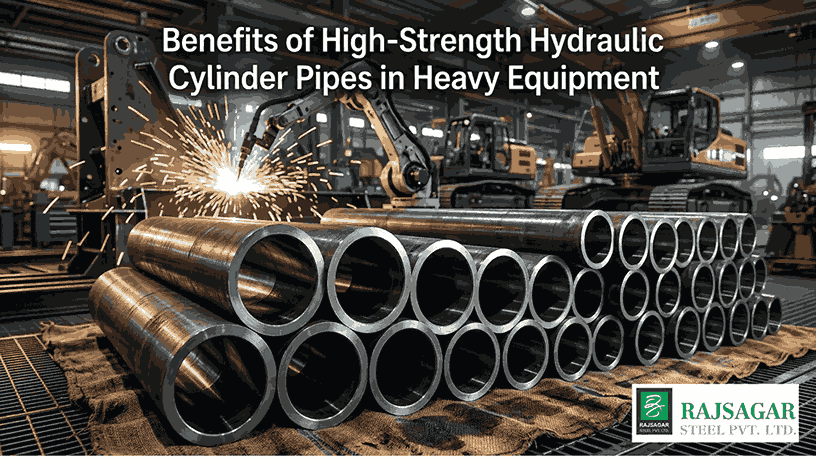
Hydraulic cylinder pipes carry the hydraulic force that powers heavy equipment. The pipe holds pressure, guides the piston, and takes structural load throughout every cycle. If the pipe is wrong in material, geometry, or surface finish, the cylinder fails early. Strength and dimensional accuracy matter.
The Backbone of Heavy Equipment – Hydraulic Cylinder Pipes
Why Hydraulic Cylinder Pipes Are Critical for Hydraulic Systems
The pipe does three things at once: contains pressure, transfers motion, and supports the cylinder assembly structurally. Operating pressures in heavy equipment hydraulics regularly exceed 300 bar. The Hydraulic cylinder pipe wall has to hold that across thousands of cycles without deforming. The bore condition controls piston friction and seal performance. A rough or out-of-round bore causes seal wear and leakage.
Performance Challenges in Heavy-Duty Equipment
Excavators, mining machines, and agricultural equipment do not operate gently. The cylinders face extreme loads, cyclic stress from repeated pressurization, contamination in the hydraulic fluid, and pressure spikes from sudden load changes. A pipe that cannot handle all of these simultaneously will fail before expected service life.
Understanding High-Pressure Hydraulic Cylinder Pipes: Design and Material Fundamentals
Hydraulic Cylinder Tube Material Specifications
Material grade sets the ceiling on what the pipe can handle. Tensile strength, yield strength, and fatigue resistance all come from the material. The table below covers standard specifications for hydraulic cylinder pipes.
| Property | Typical Requirement |
| Material Grades | SAE 1020, SAE 1026, ST52, E355 |
| Surface Finish | RA 0.1 to 0.2 μm |
| Tolerances | H7, H8, H9 |
| Construction | Seamless |
| Common Length | Up to 6 meters |
| Pressure Suitability | High-pressure systems |
Common Material Grades
SAE 1020 suits lower-pressure applications. Most mid-range hydraulic cylinders are built to the standard SAE 1026 which gives better strength with good machinability. ST52 is for heavier loads and higher pressures with much higher yield strength. The most common grade used in precision honed hydraulic cylinder tubes for European and export markets is E355, specified under EN 10305-1.
Mechanical Properties Required for Hydraulic Applications
Tensile strength is the maximum stress the pipe material can withstand before fracture. For hydraulic cylinder pipes, this is not usually the limiting factor, but it defines the safety margin.
Yield strength is more critical in practice. The material permanently deforms after it has yielded. Any permanent deformation of a hydraulic cylinder pipe will directly affect the bore geometry and the sealing performance.
Toughness is the ability of a material to absorb energy before it breaks, especially when it is struck or when the pressure changes rapidly. Heavy equipment experiences pressure spikes. While a material may not fail under steady-state pressure, it may crack under such conditions if it has low toughness.
The Importance of Seamless Construction
Seamless hydraulic cylinder pipe stockist products are preferred because the absence of a weld seam removes the main crack initiation point under cyclic loading. Rajsagar Steel produces seamless pipes through hot finishing for larger diameters and cold drawing or cold pilgering for precision sizes from 10 mm OD to 108 mm OD. The smooth process yields a homogeneous grain structure and uniform mechanical properties throughout the wall.
Dimensional Accuracy and Precision Requirements
The internal diameter of the cylinder pipe should be accurate enough for the good sealing and piston movement. If the ID varies along the length, the seal will not make equal contact, and the cylinder will leak.
Concentricity is the measure of the alignment of inside and outside diameters on the same axis. Bad concentricity means varying thickness of the wall. This causes stress concentration during pressurizing.
Straightness is important for the piston rod to travel without binding. A pipe that bows even slightly will cause side loading on the piston seals and rod, which accelerates wear.
Tolerance requirements for hydraulic cylinder pipe IDs are typically in the H7 to H9 range depending on application. These are tight tolerances that require controlled manufacturing and finishing processes.
Precision Honed Hydraulic Cylinder Tubes and Their Performance Benefits
What Honing Does and Why It Matters
Honing is an abrasive internal finishing process applied after pipe forming. It corrects minor bore geometry variations and brings the surface finish within specification. The result is a bore that is smooth, geometrically accurate, and within the required dimensional tolerance.
Seal performance depends directly on bore condition. A rough bore wears seals faster. Leakage occurs because the bore irregularity prevents the seal from maintaining complete contact. A precision honed pipe for hydraulic systems also reduces the friction of the piston, which reduces the heat generation and energy loss over each cycle.
Surface Roughness and Tolerance Requirements
Standard surface roughness for honed hydraulic cylinder bores is Ra 0.1 to 0.2 micrometers. Bore tolerances follow the ISO H system. H7 is used where tight fit is required. H8 covers most standard hydraulic cylinder applications. H9 is for lower-precision applications. The correct tolerance depends on operating pressure, piston design, and seal type.
Hydraulic Cylinder Barrel Pipe Durability in Demanding Conditions
Withstanding Extreme Pressures and Loads
For demanding applications, heavy equipment can utilize hydraulic cylinders that are required to operate at pressures over 300 to 400 bar. The cylinder pipe should withstand such pressure repeatedly during the total service life of the equipment. The pipe wall thickness is dictated by the tensile strength of the pipe and maximum operating pressure. An appropriate safety factor is used.
Under continuous operation, thermal effects also come into play. Hydraulic fluid heats up under pressure, and the pipe temperature rises accordingly. Material properties change slightly with temperature, so the material grade has to maintain adequate strength across the operating temperature range.
Resistance to Wear, Fatigue, and Cracking
Fatigue failure is one of the more common failure modes in hydraulic cylinder pipes. The pipe does not fail from a single high-pressure event. It fails after many thousands of pressure cycles because each cycle causes small amounts of crack propagation at stress concentrations.
Material toughness, the absence of weld seams, good surface finish, and correct material grade all contribute to fatigue resistance. A seamless pipe with a well-honed bore and the correct material grade will have a significantly longer fatigue life than a welded pipe with a rough internal surface.
Internal wear from piston contact is controlled primarily by bore hardness and surface finish. The honing process improves surface finish and thus reduces abrasive contact. Some applications need surface treatments or induction hardening of the bore for additional wear resistance.
Corrosion Resistance in Harsh Environments
Carbon steel hydraulic cylinder pipes are not inherently corrosion-resistant. Outdoor equipment, marine applications, and environments with water contamination in the hydraulic fluid all accelerate corrosion. The internal bore is exposed to hydraulic fluid, which provides some protection when fluid condition is maintained. The external surface is typically painted or coated.
Corrosion behavior is affected by material selection. Higher alloy grades have greater inherent resistance. The external surface is subjected to additional surface treatments or corrosion resistant coatings for aggressive environments. The bore surface is protected mainly by keeping the fluid clean.
Extending Service Life Through Material Selection
The cost of a higher grade material such as E355 over a standard carbon steel pipe is relatively small when compared to the overall cost of a hydraulic cylinder assembly or the cost of field maintenance. Choosing the right material at the procurement stage will decrease the frequency of replacements.
Hydraulic cylinder barrel pipe durability directly affects equipment uptime. Every unplanned maintenance event costs time and money. Using a pipe grade that is appropriate for the operating conditions eliminates many of these events before they happen.
High-Pressure Hydraulic Cylinder Applications Across Heavy Industries
Construction Equipment Applications
Excavators use hydraulic cylinders to operate the boom, arm, and bucket. These cylinders handle large loads and operate continuously through a working shift. Cranes and lifting systems depend on hydraulic cylinders for vertical lift, where any failure under load is a safety issue. Loaders and dozers use hydraulic cylinders for blade and bucket control. The operating conditions include shock loads, contamination, and temperature variation.
Mining Machinery Applications
Underground and surface mining equipment puts some of the hardest demands on hydraulic systems. Load handling, dump body lifting, and support system actuation all require cylinders that can handle very high loads in abrasive environments. Maintenance access is often limited in mining environments, so cylinder longevity matters more than in applications where easy access is available.
Agricultural Machinery Applications
Tractors, combine harvesters, and seeder equipment use hydraulic cylinders for implement control, steering, and chassis adjustment. Agricultural hydraulic systems are exposed to dust, water, crop debris, and temperature variation across seasons. Seal life and bore condition are critical because agricultural equipment typically does not receive the same maintenance frequency as industrial equipment.
Oil and Gas Equipment Applications
Hydraulic control systems in oil and gas facilities and on offshore platforms operate in harsh chemical and environmental conditions. High-pressure hydraulic cylinder applications in this sector include valve actuation, drilling equipment, and blowout preventer systems. Material specifications are strict, and full traceability documentation is required.
Robotics and Industrial Automation Systems
Hydraulic actuators used in industrial automation require very precise bore geometry to achieve the positional accuracy needed for repeatable motion. In these systems, stick-slip behavior and bore irregularity directly affect output quality. Precision honed hydraulic cylinder tubes with H7 tolerances are typically specified for these applications. The surface finish requirement is often tighter than standard hydraulic cylinder specifications.
Manufacturing, Standards, and Supplier Selection
Manufacturing Capabilities and Technical Expertise
The manufacturer has to be able to produce the required size range, material grade, and surface finish. Not all manufacturers can produce precision honed tubes. Not all can achieve H7 tolerances consistently. The production capability has to match the technical requirements of the application.
We produce seamless pipes from 10 mm OD to 108 mm OD in cold drawn and cold pilgered condition, which covers the size range for most hydraulic cylinder applications. Our engineering team has direct experience with the specifications required across sectors.
Supply Capacity and Product Availability
The timing of projects depends on the availability of materials. A manufacturer or stockist with sufficient stock can supply standard sizes quickly. Special tolerances or custom sizes take longer. You need to know the lead times before you commit to a project schedule to avoid delivery issues.
Customization Options for Hydraulic Systems
Standard sizes cover many applications, but hydraulic cylinders are often application-specific. Custom OD, custom ID, custom wall thickness, specific tolerance class, and specific surface finish requirements all need to be producible by the supplier. Custom lengths reduce cutting waste on site.
Choosing a Reliable High-Pressure Hydraulic Cylinder Pipes Supplier
For procurement of high-pressure hydraulic cylinder pipes, the supplier has to provide material test certificates with full traceability to the heat of steel. ISO 9001 certification indicates a documented quality system. Experience in the specific application area matters because requirements differ between, for example, oil and gas and agricultural machinery.
As a high-pressure hydraulic cylinder pipes supplier with ISO 9001:2008 certification and over five decades of production experience, we offer the documentation and quality systems that procurement teams in regulated industries require.
Common Problems Caused by Poor-Quality Hydraulic Cylinder Pipes
Leakage and Seal Failure
Bore surface irregularities cause seals to leak. A bore that is out of tolerance allows hydraulic fluid to bypass the piston seal. Even a small amount of leakage reduces cylinder efficiency and contaminates the surrounding environment. In high-pressure systems, seal failure can be sudden and serious.
Reduced Cylinder Efficiency
A rough bore increases friction on the seal and piston. Higher friction means more energy is lost moving the piston through its stroke. The cylinder delivers less usable force for the same input pressure. In equipment that is already working at capacity, this loss of efficiency translates directly into reduced productivity.
Premature Fatigue Failure
Low-grade material or welded construction accelerates fatigue crack development. In high-cycle applications, a pipe that fails from fatigue will fail long before the equipment’s expected service life. Replacement of a failed cylinder in the field is expensive, particularly when equipment downtime costs are included.
Increased Maintenance Costs
Every seal replacement, cylinder reconditioning, or early cylinder replacement adds to the total maintenance cost of the equipment. Poor-quality pipes generate these costs at higher frequency. The initial cost saving on a cheaper pipe is typically eliminated within the first maintenance interval.
Cost, Quality Problems, and Long-Term Value
Poor-quality pipes cause leakage from bore irregularity, reduced cylinder efficiency from high piston friction, premature fatigue cracking from low-grade material or welded construction, and increased maintenance frequency. Each of these adds to total operating cost.
The price difference between a standard pipe and a correctly specified precision honed seamless tube is small relative to the total cylinder cost, and much smaller than the cost of unplanned field maintenance. Long-term operating cost is the correct measure. That comparison consistently favors proper material selection and seamless precision construction.
Conclusion: Maximising Heavy Equipment Performance with High-Strength Hydraulic Cylinder Pipes
Material grade, seamless construction, and bore finish are the three things that determine hydraulic cylinder pipe performance. Getting any one of them wrong affects the others. Selecting a manufacturer with the technical capability and quality systems to deliver all three consistently is not optional in demanding applications.
Rajsagar Steel PVT. LTD manufactures seamless hydraulic cylinder pipes and precision honed tubes meeting DIN 2391 and EN 10305-1, with complete material traceability and ISO 9001 documentation. For procurement requirements across construction, mining, oil and gas, agricultural, and industrial sectors, contact Rajsagar Steel to discuss grades, sizes, tolerances, and supply capacity.